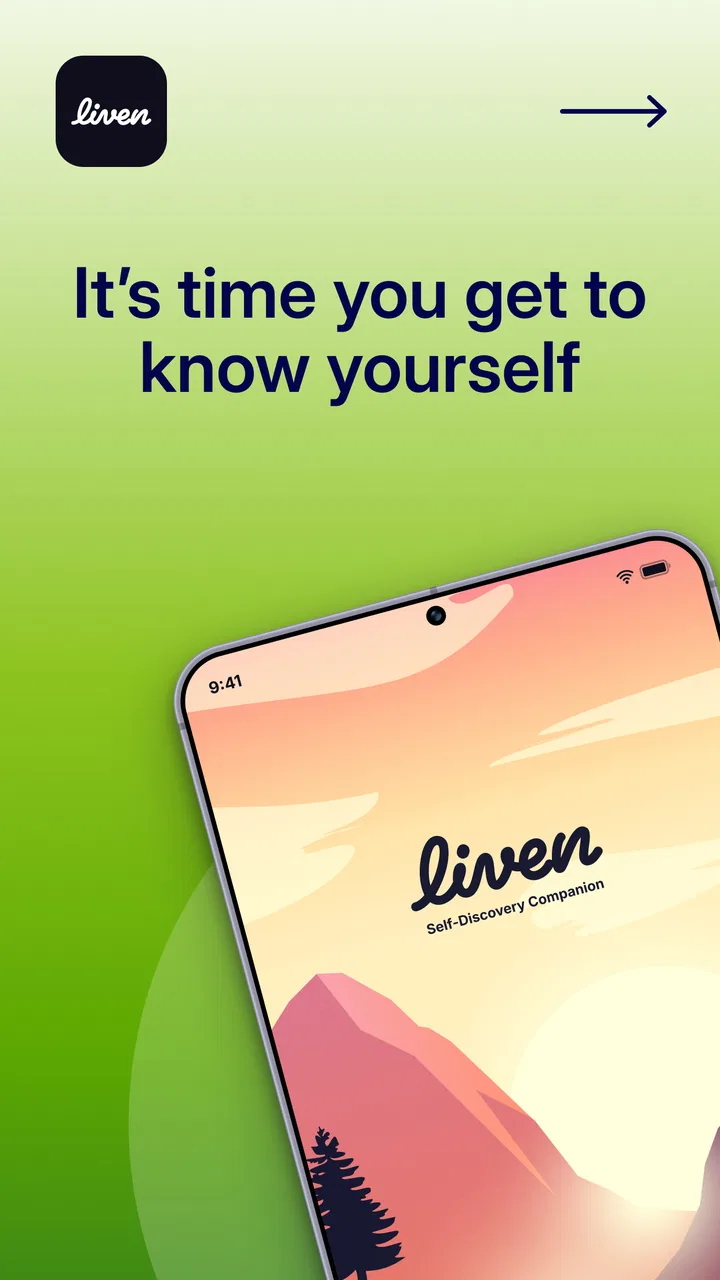
Liven: Discover yourself
- 3.9
- Rating
- 1.00M
- Installs
- Free
- Price

 Analysis by App-foxy
I approached Liven: Discover yourself as a lifestyle app rather than a tool that promises to fix everything at once. Its appeal is quieter: it gives self-reflection a more deliberate place in a phone routine. After spending time with it, my main impression is that it works best when you want to pause, notice patterns in your thoughts, and turn vague feelings into something you can examine. It is less convincing if you expect instant advice, a complete wellness program, or a substitute for professional support.
That distinction matters because many lifestyle apps compete for attention with reminders, streaks, dramatic progress screens, and constant notifications. Liven feels more useful when treated as a personal check-in space. I found that the value depends heavily on how honestly and consistently I used it. A rushed tap through reflective content produced little, while a few quiet minutes with a specific question often gave me something practical to think about later.
What makes Liven worth trying
LivenTech presents the app in a simple way, but its place in the lifestyle category is broader than a basic diary. I would describe it as a guided self-discovery companion. That wording is important: the experience is not only about recording what happened during the day. It encourages you to look at reactions, habits, priorities, and recurring emotional situations from a little distance.
You May Also Like

 Blood Strike: 2.5 Anniversary
Blood Strike’s Loadouts Turn Every Drop Into a Tactical Gamble
A close look at Blood Strike’s custom loadouts: how fast access to signature weapons reshapes its battle royale rhythm, rewards preparation, and narrows the gap between fights.

 Pandora - Music & Podcasts
Pandora’s Music Is Easy to Start, but Harder to Recover
Pandora’s strength is its low-effort path from a seed to a station. Its weak spot is how much confidence it asks you to place in connection, setup, and quiet recovery.

 8 Ball Pool
 Is Built on Rivalries, Rematches, and Routine
A close look at the rivalries, rematches, shared routines, and unanswered safety questions that turn a quick pool match into a persistent mobile community.

 Samsung Music
’s Quiet Strength Is Playing What You Already Own
Its reach comes less from spectacle than from dependable access to a personal library. That simplicity is both the app’s strongest retention engine and its ceiling.

 AccuWeather: Weather Radar
AccuWeather Review: A Quick, Clear Forecast for Everyday Decisions
For everyday plans, the best forecast is the one you can understand quickly. AccuWeather makes rain timing, radar, and local conditions easy to act on, with a few trade-offs.

 Hill Climb Racing
Why Hill Climb Racing Still Turns Crashes Into One More Run
A tiny car, a bumpy hill and one more upgrade: Hill Climb Racing keeps resurfacing because its simple chaos makes every near-miss feel personal.
More From Our News Desk
View All News


My strongest positive impression came from the way the app can turn an indistinct mood into a starting point for reflection. When I felt generally overwhelmed, writing “I have too much to do” would have been easy but not especially useful. A more focused approach was to ask what part of the situation bothered me most: the workload, the lack of control, the fear of disappointing someone, or the difficulty of deciding where to begin. That kind of narrowing is where a self-discovery app can earn a place on the home screen.
The app also suits people who dislike the blank page. Traditional journaling gives complete freedom, but that freedom can become a barrier. I have opened an empty notes app with the intention of reflecting and then closed it because I did not know how to start. A guided format removes some of that friction. It gives the mind a direction without requiring a polished answer, which makes short sessions more realistic on busy days.
A useful habit is to avoid treating every session as a test that must produce a breakthrough. I got more from using it as a small observation exercise. If I noticed the same concern appearing repeatedly, that was already information. Instead of trying to solve the issue immediately, I could look for the situation that triggered it and decide whether the next step was practical action, a conversation, rest, or simply accepting that the feeling was present.
That makes Liven particularly relevant for people who are curious about self-awareness but do not want a highly clinical or technical experience. It can help organize thoughts that are otherwise scattered across messages, notes, and mental reminders. I would not call it a replacement for therapy, and I would not use it as a crisis resource. Its strength is everyday reflection, not diagnosis or treatment.
A realistic way to use it during a normal week
Imagine finishing a workday irritated by a short message from a colleague. The easy response is to replay the message repeatedly and assume the other person intended to be dismissive. A more productive Liven session would be to separate the event from the interpretation. What exactly was written? What did I assume it meant? Was I already tired or defensive? What response would serve me tomorrow rather than merely release frustration tonight?
I found this kind of sequence more valuable than trying to force a positive attitude. The point is not to declare that everything is fine. It is to create enough space between the event and the reaction to choose a better response. For someone who tends to overthink conversations, that is a concrete use case. For someone who wants a motivational feed or a detailed task manager, it may feel too inward-looking.
Another practical workflow is to use the app before making a decision that feels emotionally loaded. I would first write down the choice in plain language, then identify what I wanted, what I feared, and what outcome I could actually influence. The benefit is not that the app selects an answer. The benefit is that it makes hidden assumptions easier to notice. I would still compare options, check facts, and speak with people affected by the decision.
This is also where I noticed an important trade-off. Guided reflection can make thinking easier, but it can also steer attention toward the questions the app presents. That is helpful when I am stuck, yet it means I should not confuse the prompts with a complete picture of my life. I still need my own judgment, and sometimes an ordinary conversation with a trusted friend gives a more useful perspective.
Where the experience feels strong and where it slows down
The strongest part of the experience is its potential to make reflection repeatable. A single thoughtful session can be pleasant, but a pattern of returning to the same themes is more revealing. I recommend using a consistent moment, such as after dinner or before putting the phone away, rather than opening it only when something feels wrong. That turns self-discovery into maintenance instead of an emergency response.
There is also a privacy-minded habit I would recommend even before starting: decide what level of detail feels comfortable. Personal reflection can become more useful when it is specific, but you do not need to include names, confidential work information, or details that could identify another person. Writing “a difficult meeting” may be enough to examine your reaction without turning the entry into a record of someone else’s private information.
The main weakness is that this type of app can feel repetitive if you already have a strong journaling practice. Someone who enjoys writing freely may find prompts restrictive or unnecessary. I sometimes wanted to move directly from an observation to my own question instead of following a guided direction. In those moments, a plain notes app was faster and more flexible.
There is another limitation: reflection does not automatically become change. It is possible to understand why I procrastinate, recognize the emotion behind an argument, and still repeat the same behavior the next day. Liven can help me notice the pattern, but I remain responsible for choosing a small action. I got the best results when I ended a session with one observable next step, such as sending a message, blocking time for a task, or postponing a difficult discussion until I was calmer.
Users should also consider the subscription model before becoming dependent on the experience. The app is free to download, while in-app purchases range from $7.99 to $104.99 per item. I would explore the free experience first and decide whether the paid options genuinely add value to my routine. A lifestyle app should not become another source of pressure, especially if the purchase is driven by fear of missing out rather than clear usefulness.
For families, the Everyone content rating makes the app broadly approachable, but that does not mean every reflection topic will feel equally suitable for every age or personality. I would encourage younger users to treat it as a prompt for thinking rather than an authority. A parent or trusted adult can be a better source of context when a question touches on serious emotional difficulty.
How it compares with familiar alternatives
Compared with a paper journal, Liven is easier to open when I want direction, but paper gives me more freedom and fewer distractions. A notebook is also better for people who enjoy long-form writing, sketches, lists, or a private ritual away from screens. I would choose Liven when I need help beginning, and paper when I already know what I want to explore.
Compared with a standard notes app, Liven has a clearer reflective purpose. Notes are excellent for capturing anything quickly, from shopping lists to half-formed ideas, but they do not necessarily encourage me to examine a reaction or recurring habit. The trade-off is flexibility. Notes win when I want total control over structure, while Liven is more useful when the problem is not storage but knowing what to ask myself.
Compared with meditation apps, the emphasis feels different. Meditation is often about attention, breathing, and returning to the present moment. Liven is better suited to putting thoughts into words and considering what they mean. If I am physically tense and unable to settle, a breathing exercise may be the better first step. If I am calm enough to examine a decision or emotional pattern, Liven makes more sense.
It also differs from habit trackers. A tracker can show whether I completed a behavior, but it may not explain why the behavior keeps failing. Liven is more useful for exploring motivation, resistance, or conflicting priorities. On the other hand, if my goal is simply to remember water, exercise, or a daily task, a dedicated tracker is likely more direct and less demanding.
Who will get the most from it
I would recommend Liven to someone who often says, “I know something is bothering me, but I cannot explain what.” It is a good fit for people beginning a journaling habit, people navigating a transition, and people who want a structured way to review reactions without turning every thought into a public post. It may also suit busy users who can spare a short, regular pause but do not want to maintain a complex personal system.
It is less suitable for someone seeking medical guidance, formal mental-health treatment, detailed productivity planning, or a social community. It is also not my first choice for a person who strongly dislikes guided prompts. In that case, a blank notebook or notes app will probably feel more natural. The right question is not whether Liven is universally better than those alternatives; it is whether structure helps you reflect more consistently than you do on your own.
The app has reached over one million installs and holds a 4.2 average from around thirty-six thousand ratings, with roughly one and a half thousand written reviews. Those figures suggest that the concept has connected with a substantial audience, but they should not replace a personal trial. Self-reflection tools are unusually dependent on fit: the same prompt style that helps one person get unstuck can make another feel boxed in.
Practical details before you begin
Liven is free, with optional in-app purchases, and its content rating is Everyone. It was released on November 28, 2023, and the current version is 1.132.1. Android users need version 8.0 or later. I would check compatibility before planning to use it on an older device, then spend a few days testing whether the routine actually fits my schedule before considering any purchase.
My advice is to begin with a narrow purpose rather than trying to “discover yourself” in one sitting. Choose one recurring situation: difficulty saying no, anxious reactions to messages, trouble starting work, or uncertainty about a personal decision. Use the app to examine that theme, write honestly but safely, and finish by identifying one small action. After several sessions, review what keeps returning. That process is more useful than collecting reflections without acting on them.
I would also avoid opening it only at the most emotionally intense moment. When I am angry or exhausted, my interpretation is less balanced. A short pause, a glass of water, or a walk can come first. Returning to the app when I can distinguish facts from assumptions produces better reflection and reduces the chance of using it to justify an impulsive reaction.
My final view is favorable but measured. LivenTech has made a lifestyle app that can give self-reflection enough structure to become a real habit, especially for people who find blank-page journaling intimidating. Its best contribution is not a dramatic answer; it is the small shift from reacting automatically to noticing what is happening inside me and deciding what to do next.
Liven is worth trying if you want guided self-discovery and are willing to participate honestly. I would skip it if you need professional care, a robust task system, or completely open-ended writing. For the right user, the free starting point makes experimentation easy, while the paid options deserve a careful value check. Used as a thoughtful companion rather than an authority, it can become a practical pause in an otherwise crowded day.
FAQs for Liven: Discover yourself
01What is Liven: Discover Yourself?
Liven: Discover Yourself is a self-improvement app designed to help users explore their inner potential through guided meditations, personalized challenges, and insightful content. It aims to enhance mental well-being and foster personal growth by providing tailored experiences suited to individual needs and preferences.
02Is Liven: Discover Yourself free to use?
Liven offers a free basic version with limited content and features. However, to access the full range of personalized content, in-depth insights, and advanced features, users can opt for a premium subscription. Pricing details and subscription plans are available within the app.
03What platforms is Liven: Discover Yourself available on?
Liven: Discover Yourself is available for download on both Android and iOS platforms. Users can find the app on the Google Play Store for Android devices and the Apple App Store for iOS devices, ensuring broad accessibility across different smartphones and tablets.
04How does Liven: Discover Yourself personalize content for users?
The app uses a combination of user inputs, such as preferences and goals, along with AI-driven algorithms to tailor content. This personalization ensures that users receive the most relevant exercises, meditations, and challenges, enhancing their journey toward self-discovery and personal growth.
05Can I use Liven: Discover Yourself offline?
Liven requires an internet connection for initial setup and to access new content updates. However, once content is downloaded, users can access certain features offline. This is especially useful for users who want to continue their self-discovery journey without needing constant internet access.
Pros
- Intuitive interface for easy navigation.
- Personalized insights for self-discovery.
- Wide range of mindfulness exercises.
- Daily challenges to boost motivation.
- Connects with a supportive community.
Cons
- Limited offline access to features.
- Subscription required for full access.
- Notifications can be overwhelming.
- Some exercises are repetitive.
- Occasional app performance lags.

Liven: Discover yourself
Gallery